
Your second hosting bill is higher because the intro rate bought a term, not a price. A term is the block of months you paid for up front. When that term ends, the account moves to the provider’s regular rate. That regular rate is called the renewal rate, and across the shared plans we track it is a median of 2.5 times the signup rate.
The fix is arithmetic, not outrage. Work out the three-year cost before you buy, pick the term deliberately, and put the renewal date in a calendar. This guide shows the math with real numbers from our hosting directory.
Short answer: the intro rate buys a term, not a price
Shared hosting is sold the way gym memberships and mobile contracts are sold. The first term is discounted to win the signup, and the provider expects to recover it later. The renewal rate is the number the business actually runs on. Nothing about that is hidden. It sits on the pricing page in small type, and some hosts publish a dedicated renewal-pricing table. The checkout flow is simply designed around the big number, not the small one.
Three facts decide what you will pay, and only one of them appears in most comparison charts.
- The intro rate applies once, for one term, to a new account.
- The term length decides how long the intro rate lasts. You usually pay the whole term up front.
- The renewal rate applies from the next term onward. At several providers it also depends on the term you renew into.
Our catalog holds 27 shared plans with a published renewal rate. Of those, 23 renew at twice the intro price or more, and 10 renew at three times or more. The widest gap we track is a first-year plan at $0.99/mo that renews at $17.99/mo, a factor of 18. Prices in this article are as of September 2026 and were checked on Sep 17, 2026.
How intro and renewal pricing actually works
A hosting account is a subscription with a billing cycle. Choose a 36-month cycle and you pay 36 months in advance at the intro rate. When the cycle closes, the provider charges the next 36 months at the regular rate unless you cancel. Choose a 12-month cycle and the same thing happens after twelve months. That is why the cheapest headline often turns into the most expensive account.
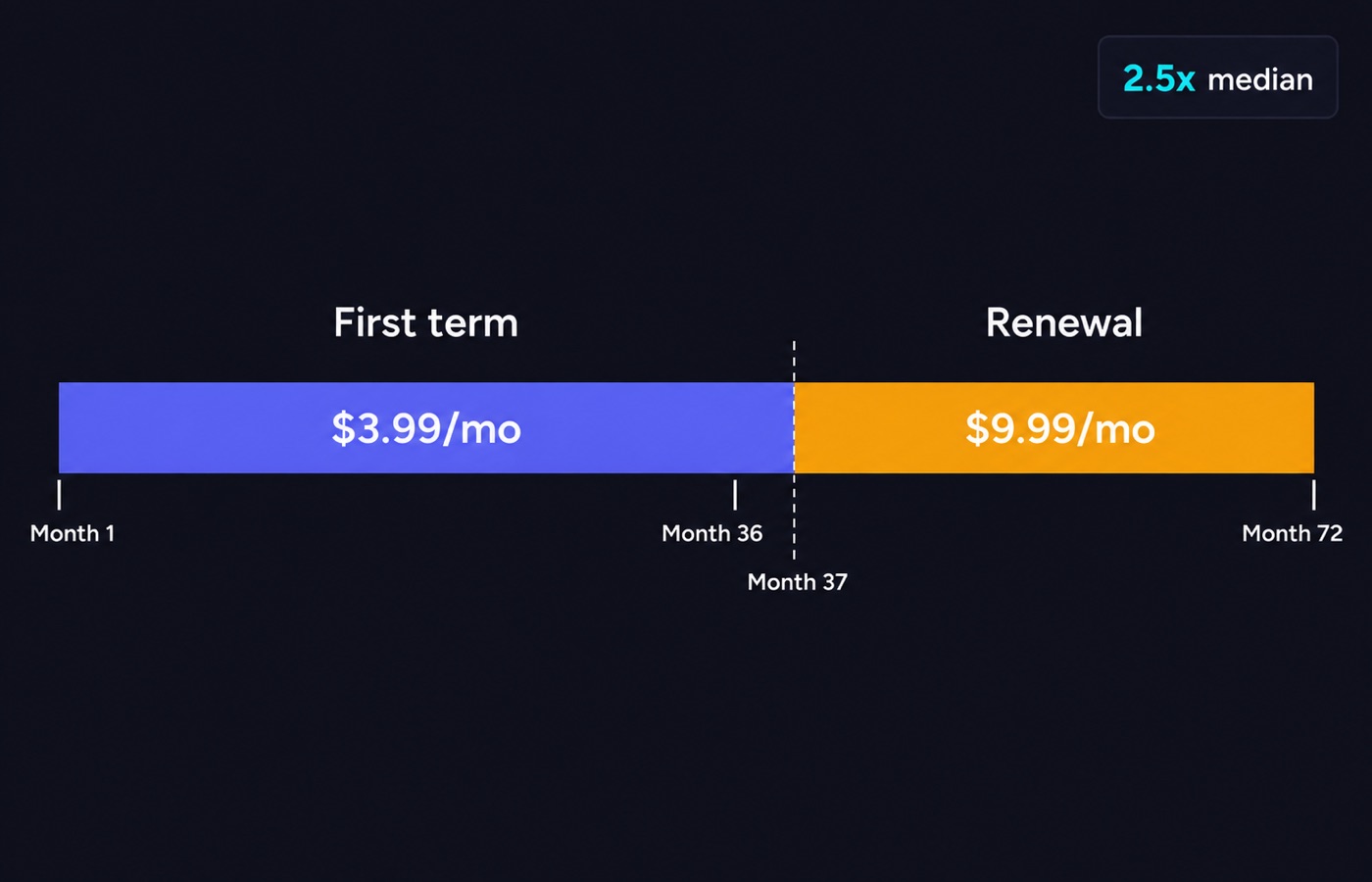
Two mechanics catch people out. The first is that the renewal rate is often tied to the term, not just to the plan. HostPapa’s published renewal for its entry shared plan is $8.99/mo on a 36-month cycle, but $12.99/mo on monthly billing. The cycle you pick at renewal changes the rate you renew at.
The second is that a plan’s cheapest intro rate and its cheapest renewal rate are often on different terms. InMotion Hosting’s Launch plan has its lowest monthly intro on the 12-month cycle at $4.79/mo, which renews at $14.99/mo. The 36-month cycle is $4.99/mo and renews at $13.99/mo.
Bundled extras follow the same pattern. A free domain, a free SSL upgrade or a migration credit is usually first-term only. The domain then renews on its own registry-driven schedule, which has nothing to do with your hosting cycle. Read the checkout summary, not the feature grid.
Three-year math: what each term really costs
Here is the comparison that matters, built from our catalog data. Each row takes an entry shared plan, runs it for 36 months at the published rates, and reports the total and the effective monthly cost. Where the first term is shorter than 36 months, the remaining months are charged at the provider’s published regular rate.
| Plan | Intro | First term | Rate after | 36-month total | Effective |
|---|---|---|---|---|---|
| HostPapa Web Hosting Essentials | $2.95/mo | 36 months | $8.99/mo | $106.20 | $2.95/mo. |
| Hostinger Premium Web Hosting | $2.99/mo | 48 months | $10.99/mo | $107.64 | $2.99/mo. |
| Bluehost Starter | $3.99/mo | 36 months | $9.99/mo | $143.64 | $3.99/mo. |
| Vultr Cloud Compute 1 vCPU / 1 GB | $5.00/mo | None, billed hourly | $5.00/mo | $180.00 | $5.00/mo. |
| WebHostingPad Power Plan, 1-year cycle | $3.99/mo | 12 months | $6.65/mo | $207.48 | $5.76/mo. |
| Turbify Web Hosting Essentials, 1-year cycle | $2.99/mo | 12 months | $7.99/mo | $227.64 | $6.32/mo. |
| Web Hosting Hub Spark, 1-year cycle | $7.99/mo | 12 months | $12.49/mo | $395.64 | $10.99/mo. |
| InMotion Hosting Launch, 1-year cycle | $4.79/mo | 12 months | $14.99/mo | $417.24 | $11.59/mo. |
Data checked Sep 17, 2026. The rates are the ones published for US customers, and they exclude domain fees and taxes. Two notes on honesty. The Hostinger row prepays 48 months, so the 36-month figure covers three years of a four-year purchase rather than a complete cycle. The Web Hosting Hub figure uses the struck-through regular rate shown next to the promotional price, because that provider does not label a separate renewal rate.
The spread is the story. The same three years costs $106.20 at the top of the table and $417.24 at the bottom. That is a difference of $311.04 for a comparable entry plan. None of that spread comes from server quality. It comes from the term you agreed to.
Term length is the lever, not the sticker price
Compare a provider with itself and the effect is obvious. InMotion Hosting’s Launch plan costs $417.24 over three years on annual cycles. The same plan at the same host costs $179.64 on a single 36-month cycle at $4.99/mo, which is $237.60 less. Turbify’s entry plan is $227.64 on annual cycles, against $89.64 on a 36-month cycle at $2.49/mo, a $138.00 difference. Web Hosting Hub’s Spark is $395.64 annually, against $215.64 on the 36-month cycle, a $180.00 difference.
Longer is not always better, and the reason is risk rather than arithmetic. WebHostingPad’s $1.99/mo headline is only available on four- and five-year cycles. The three-year rate is $2.29/mo, two years is $2.99/mo and one year is $3.99/mo. Five years at $1.99 means $119.40 handed over today against a 30-day money-back window, for a service you cannot evaluate for five years.
The middle path most people want is a 24 to 36-month cycle on a host whose renewal rate you have already read. A provider with no intro-renewal split at all works too. Hourly and monthly billing removes the mechanic entirely, since an instance at $5.00/mo costs $180.00 over three years with no step at month 13. Our hourly-billed VPS page lists the providers that work that way, and the cheap web hosting under $5 page shows which shared plans start there.
Refunds and money-back windows
The money-back guarantee is the only part of this that gives you leverage. It is also shorter than the evaluation period most sites need. Among the nine providers in our catalog, InMotion Hosting and Web Hosting Hub publish 90-day money-back guarantees, and six of the remaining seven publish 30 days. Vultr publishes none, but it bills hourly and by prepaid credit, which serves the same purpose.
Three conditions apply almost everywhere. Confirm them in the terms before you rely on them. Guarantees usually cover the hosting fee only, so a bundled domain registration is either deducted from the refund or kept by you at its normal price. They usually apply to the first purchase, not to a renewal, which is exactly when you would most want them. And the clock starts at purchase, not at launch, so three weeks of building the site eats most of a 30-day window.
The practical move is to compress the evaluation into the window. Point a staging subdomain at the new account on day one. Staging means a working copy of the site that visitors do not see. Push the real site’s traffic profile through it, then check the three things a refund cannot fix later.
Measure time to first byte from your audience’s region. Watch how support answers a technical ticket rather than a sales one. See whether the resource meters in the panel are visible to you at all. Two weeks of that is worth more than eleven months of drifting.
US law gives you a second, weaker layer. The Restore Online Shoppers’ Confidence Act covers sellers who charge online through a negative-option feature, where silence counts as consent to keep billing. They must disclose the material terms clearly before they take your billing information, and give you a simple way to stop recurring charges. So the renewal rate and cycle should be findable at checkout, and cancelling auto-renew should not require a phone call. The law does not cap what a host may charge on renewal.
How to plan the renewal before it lands
Treat the renewal as a scheduled decision rather than a surprise. The work takes ten minutes at signup and saves a three-figure sum at month 13 or month 37. Do it in this order, and write the numbers somewhere you will find them a year later.
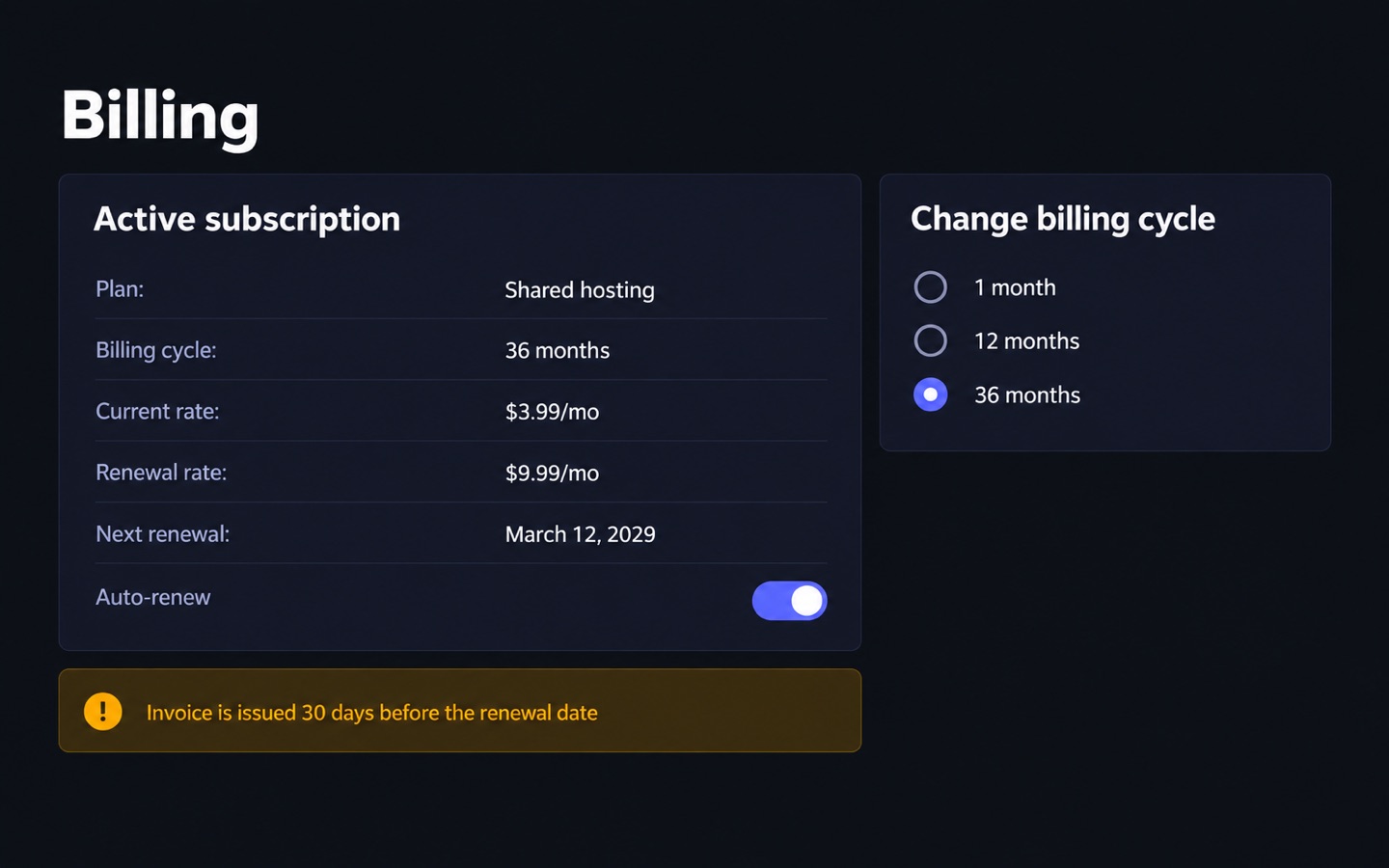
- Record three values at purchase: the renewal date, the renewal rate for your exact term, and whether auto-renew is on.
- Save a copy of the pricing page. A PDF print of the page you bought from settles most billing disputes in one email.
- Set a reminder 45 days before renewal. Many hosts invoice 15 to 30 days early, so a 30-day reminder arrives after the card has been charged.
- Re-price the plan at the reminder. Compare your renewal rate against current intro and renewal rates for equivalent plans, not against intro rates alone.
- Decide between three options: renew as-is, renew on a longer cycle at a lower rate, or move. Moving a small site is a weekend, and the three-year difference can be $237.60.
If you do move, size the destination from measured numbers rather than from the plan you happen to be on. Our guide on how much disk space and bandwidth you need covers that arithmetic. The web hosting comparison lists renewal rates alongside intro rates, so the two are visible together.
What to check before you sign up
Run this list at checkout, before the card details go in. Every item is answerable from the provider’s own pages in under a minute, and each one has cost somebody real money.
- The renewal rate for the exact term you are buying, not the shortest or longest one on the page.
- Whether the renewal rate itself changes with the cycle you renew into, as it does at HostPapa.
- What is first-term only: domain, SSL beyond the free certificate, backups, migration, email add-ons.
- The money-back window and its exclusions, especially whether a bundled domain is deducted.
- Whether monthly billing exists at all, and what it costs, since that is your escape route.
- The resource caps behind any “unlimited” claim: inode limits, entry processes, CPU and memory.
One more question is worth putting to support in writing before you buy. Ask what happens to the price if you change plan mid-term. Some providers re-price the whole account at current rates when the plan changes, which ends the intro period early without anyone announcing it.
We record prices from each provider’s own pricing pages and stamp them with a check date. How and why is described in our editorial policy, and how we make money is in the affiliate disclosure.
Common mistakes
Most of these are decisions made at signup that only become visible a year later.
- Ranking hosts by intro price. An entry plan at $2.99/mo that renews at $10.99 loses to one at $3.99 that renews at $9.99, over any horizon longer than the first term.
- Assuming the renewal rate equals the monthly rate. They are different numbers at several providers, and monthly is usually the higher one.
- Letting the refund window expire while “still testing”. A 30-day guarantee starts at purchase, not at launch.
- Forgetting the domain. A free first-year domain renews at the registrar’s standard rate on its own date, separately from hosting.
- Prepaying five years to save $1/mo. The saving is real. So is being locked to one provider through two hardware generations.
- Renewing without re-reading the plan. Storage, site counts and backup retention can change between terms. Confirm you are renewing into the plan you signed up for.
The pattern underneath all six is the same. The decision that sets your cost is made at checkout, in the term selector. It is almost never revisited until the money has already moved.
FAQ
Why is my hosting renewal so much higher than what I paid? Because the first invoice was a promotional rate attached to one billing cycle, and the second is the regular rate. Across the 27 shared plans we track with a published renewal price, the median renewal is 2.5 times the intro rate. Of those 27 plans, 23 are at least double. Nothing was added to your account. The discount simply ended.
Can I get the intro price again? Not on the same account, as a rule, because intro rates are defined as new-customer offers. Support can sometimes apply a retention discount or move you to a cheaper plan, and asking costs one ticket. The reliable lever is the term. Renewing on a 36-month cycle instead of a 12-month one is worth $237.60 over three years on one plan in our data.
Is it cheaper to switch hosts every year? On paper, often yes. In practice it depends on what your time is worth. A migration is a few hours for a small static site and a long evening for a database-driven one. The three-year saving ranged from $138.00 to $237.60 in the examples above. Chasing the lowest intro rate every twelve months also means never building a support history anywhere.
Does the money-back guarantee cover a renewal charge? Usually not. Guarantees are normally written for the initial purchase, which is why the renewal date matters more than the signup date. Check the terms for your provider. If you want the option to leave, keep auto-renew off and put the date in your calendar instead.
Are there hosts without renewal price increases? Providers that bill hourly or monthly with no promotional term have no increase to apply. An instance at $5.00/mo is $5.00/mo in year three. Some shared plans also hold a flat rate across terms, and where a provider publishes the same figure for intro and regular pricing, our review pages show it.
Bottom line
The second bill doubles because you bought a term at a discount and the term ended. That is legitimate, and it is also entirely predictable. Read the renewal rate for your exact cycle. Calculate the three-year total instead of the monthly headline, and decide the term with both numbers on the screen. Then set the reminder. Our VPS hosting comparison and the web hosting tables show intro and renewal rates side by side, which is the only version of this chart worth trusting.
Sources
- ftc.gov/legal-library/browse/statutes/restore-online-shoppers-confidence-act
- law.cornell.edu/uscode/text/15/8403
- hostpapa.com/renewal-pricing
- vultr.com/pricing
Written and fact-checked by the WebHostingBreak Editorial Team in line with our editorial policy. Prices quoted here come from the provider reviews we maintain and carry the date they were last checked. Spotted an error? Tell us.